
Why Pulsed IV Measurements Are Essential for RF Power Transistors

.png)
Why Pulsed IV Measurements Are Essential for RF Power Transistors
The continuous evolution of RF and microwave technologies has considerably increased the demand for accurate transistor characterization techniques. Modern devices such as GaN HEMTs, GaAs FETs, LDMOS transistors, HBTs, and advanced MMIC power amplifiers now operate at very high frequencies and power densities, under electrical conditions that conventional DC characterization methods cannot properly represent.
In real RF operation, transistors are subjected to rapid voltage and current variations occurring over nanosecond and microsecond time scales. Under these dynamic conditions, several physical phenomena alter the intrinsic behavior of the device. Thermal effects, charge trapping, and memory effects progressively modify the current voltage characteristics, creating significant discrepancies between static DC measurements and the actual RF operating behavior. This phenomenon, commonly referred to as dispersion, is particularly critical in modern GaN and GaAs technologies.
As RF systems become more demanding in terms of efficiency, linearity, and power performance, the limitations of conventional DC measurements become increasingly evident. Pulsed IV characterization has therefore become an essential technique for accurately evaluating RF power transistors under realistic operating conditions.
The Limitations of Conventional DC IV Measurements
Traditional DC IV measurements consist of progressively sweeping the drain voltage and current while the transistor remains continuously biased. During the measurement sequence, the device dissipates significant power over relatively long periods of time.
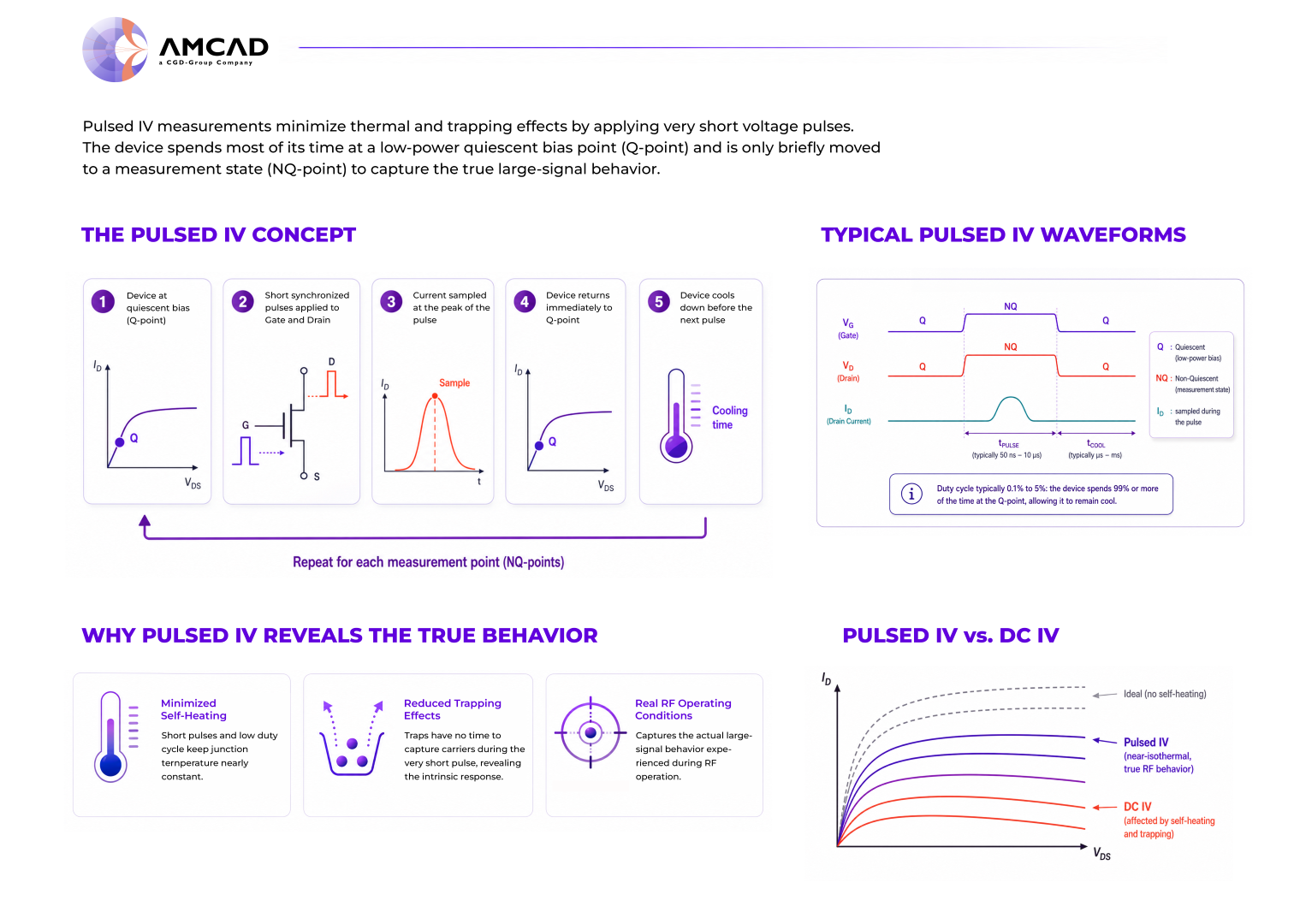
As the junction temperature rises, the electrical characteristics of the transistor begin to change. The measured IV curves progressively exhibit a droop caused by self-heating and trapping effects. Consequently, the extracted characteristics no longer represent the intrinsic behavior of the device but rather a thermally degraded operating condition.
This issue is particularly severe for high-power RF technologies such as GaN, where trapping effects and thermal phenomena strongly influence device performance. Under RF excitation, these mechanisms can produce current collapse, dynamic ON resistance variations, gain compression, and nonlinear distortion effects that cannot be predicted accurately from static DC data alone.
As a consequence, transistor models extracted exclusively from DC measurements often lead to inaccurate circuit simulations. Designers may then face discrepancies between simulated and measured RF performance, resulting in additional design iterations, increased development costs, and longer time to market.
Pulsed IV Measurements: Accessing the True RF Behavior
Pulsed IV characterization was developed to overcome these limitations by minimizing the thermal and trapping effects that occur during conventional DC measurements.
Instead of continuously stressing the transistor, the device is maintained most of the time at a low power quiescent operating point, commonly referred to as the Q-point or quiescent bias point. Very short synchronized voltage pulses are then applied to the gate and drain in order to move the device temporarily to a non-quiescent measurement state. Current is sampled during this extremely short interval before the transistor immediately returns to its quiescent condition.
Because the duty cycle is very low, the device has sufficient time to cool between successive pulses. In many practical cases, the transistor may spend only 1% of the total time in the active pulsed state and 99% at the quiescent bias condition. This approach enables measurements to be performed under quasi-isothermal conditions, much closer to the actual operating environment encountered in RF applications.
The resulting IV characteristics therefore provide a much more realistic representation of the intrinsic large signal behavior of the transistor. Pulsed measurements allow engineers to accurately observe phenomena such as current collapse, dynamic trapping effects, thermal dispersion, and RF operating trajectories. This information is essential for developing reliable nonlinear transistor models and accurately predicting RF circuit behavior.
Moreover, pulsed characterization provides valuable insight into the physical mechanisms responsible for dispersion. By varying pulse duration, duty cycle, and quiescent bias conditions, engineers can study the time constants associated with trapping and thermal effects, helping both technology developers and model engineers better understand device physics.
The Importance of Timing Accuracy
Although the principle of pulsed IV measurements appears straightforward, achieving accurate and reliable results requires extremely precise timing control.
The synchronization between gate and drain pulses is particularly critical. If the pulse edges are not properly aligned, the transistor may momentarily transition through intermediate operating regions that do not correspond to either the quiescent or measurement state. In some situations, these transient conditions may force the device outside its safe operating area and potentially damage the transistor under test.
Accurate pulsed characterization therefore requires careful control of pulse widths, delays, synchronization timing, and acquisition windows. The quality of the measurement system plays a decisive role not only in measurement accuracy and repeatability, but also in protecting expensive RF power devices during characterization.
A Solution Designed for RF and Microwave Devices
Unlike conventional laboratory setups assembled from multiple independent instruments, such as oscilloscopes and external DC power supplies, AMCAD's Pulse IV systems provide a compact and integrated solution optimized for pulsed IV and pulsed RF measurements, combined with the IVCAD control software.
The architecture allows independently adjustable gate and drain pulse timing, including pulse widths, delays, rise time, and acquisition apertures, ensuring accurate dynamic measurements while maintaining safe operating conditions for the device under test.
Synchronized pulsed IV generation and measurement can also be combined with pulsed S-parameter measurements using an RF vector network analyzer equipped with pulsed RF measurement options, allowing both DC and RF characteristics to be evaluated under identical operating conditions. This consistency between static and RF measurements is particularly important for advanced nonlinear model extraction workflows.
The platform is equally suitable for packaged devices and on-wafer measurements, and includes protection mechanisms capable of detecting abnormal operating conditions and rapidly disabling the pulse generators when necessary, providing a secure environment for characterizing valuable devices repeatably.
Improving RF Modeling and Circuit Design
One of the primary motivations for pulsed IV characterization is the extraction of accurate nonlinear transistor models.
Modern RF simulation tools rely heavily on compact device models to predict circuit behavior under large signal operating conditions. The quality of these models directly determines the accuracy of simulations involving gain compression, harmonic distortion, efficiency, and power performance.
Pulsed IV and pulsed S-parameter measurements acquired under controlled thermal conditions provide the highly accurate data required for advanced model extraction. More accurate models lead directly to more reliable circuit simulations, reducing the number of design iterations and accelerating product development cycles.
For semiconductor technology developers, pulsed measurements also provide a powerful diagnostic tool for process optimization and reliability analysis. The ability to analyze trapping phenomena, thermal behavior, and dynamic dispersion contributes significantly to the development of more robust and higher performance RF technologies.
Conclusion
As RF and microwave technologies continue to evolve toward higher frequencies and power levels, accurate dynamic transistor characterization has become indispensable.
Conventional DC IV measurements are no longer sufficient to describe the true operating behavior of modern RF power devices because they are strongly affected by self-heating and trapping phenomena. Pulsed IV characterization overcomes these limitations by enabling measurements under quasi-isothermal conditions that closely reproduce real RF operation.
For RF designers, model engineers, and semiconductor technology developers, pulsed IV characterization has become an essential tool for accurately understanding and predicting the behavior of modern RF power devices.
.png)


